The Self-Trust Loop
Why Confidence Isn’t the Starting Point
It was Tuesday, and Mark already felt behind.
Not “busy” behind. Not “I’ve got a lot on” behind.
The kind of behind that sits in your chest like a weight.
He had been up since 5:30. Coffee in hand. Laptop open. Tabs everywhere. Messages unanswered. A half-written proposal on screen that had been “almost finished” for four days.
He told himself the same thing he always told himself.
“I’ll make the call after I clear a few things.”
So he cleared a few things.
He replied to the easy emails. He tweaked the wording on the proposal again. He reorganised the project board. He checked the bank balance. He scanned social media. He did all the tiny tasks that gave him the feeling of movement without the risk of commitment.
By 10:15, the client had followed up.
“Hey Mark, just checking in. Are we good to go?”
His stomach dropped.
Because the truth was, he could answer. He knew what needed to be said. He just did not want to say it. Not yet.
If he said yes, he had to deliver.
If he said no, he risked losing the work.
If he raised the price, he risked pushback.
If he set a boundary, he risked being disliked.
So he did what he had trained himself to do.
He stalled.
He told himself he needed more information. More certainty. More confidence. More time.
He looked at his calendar and felt that familiar surge of panic.
There was no space. No breathing room. No clean block to think.
But the real reason there was no time was sitting right there in front of him.
Time was bleeding out through indecision.
Every open loop. Every delayed conversation. Every draft that never got sent. Every decision he kept reopening.
His day wasn’t full of work.
It was full of hesitation.
When he said it out loud in our session, his voice cracked. Not because he was weak.
Because he was exhausted from carrying a business in his head that he refused to put on paper with a decision.
“I feel like I’m sprinting,” he said, staring at the floor, “but I’m not going anywhere.”
And in that moment, the shift was simple and brutal.
He didn’t need a better calendar.
He needed to start backing himself.
Because confidence was not going to arrive and save him.
The only thing that was going to change his time was evidence.
Evidence that he could decide.
Evidence that he could follow through.
Evidence that he could move before he felt ready.
Most SME owners are waiting for a feeling that rarely arrives on schedule.
You are waiting to feel confident before you raise the price.
Confident before you delegate properly.
Confident before you publish the message, launch the offer, call the partner, or have the hard conversation with a team member.
And the longer you wait, the more the business quietly trains you to doubt yourself.
Because every time you delay the action you already know you need to take, you collect a piece of evidence that says:
“I don’t back myself.”
Not out loud. Not consciously.
But internally, that is what your nervous system and your identity conclude.
This is the trap: you think confidence is the input.
In reality, confidence is the output.
The lie that keeps you stalled
Here is the lie most capable operators believe:
“Once I feel ready, I’ll move.”
But readiness is not a feeling. It is a pattern.
Confidence does not appear first. Evidence appears first.
And evidence only comes from aligned action.
Not perfect action.
Not huge action.
Aligned action. The kind that proves you are the person you keep saying you are.
The Self-Trust Loop (the real sequence)
Self-trust is not a personality trait. It is a loop you either run, or you don’t.
Aligned action → Evidence → Self-trust → Confidence → Bigger aligned action
When you take an action that matches your next-level identity, even if it is small, your brain logs it as proof.
Proof that you do what you said you would do.
Proof that you can tolerate discomfort.
Proof that you can move without certainty.
That proof becomes self-trust.
And self-trust becomes the foundation for confidence.
So if you have been waiting for confidence, what you are really waiting for is evidence.
And evidence is built one rep at a time.
Why your “confidence problem” is often an identity mismatch
This is where it gets confronting for SME owners.
You are not actually struggling because you lack confidence.
You are struggling because you are attempting to operate a next-level business using an old operator identity.
Your old identity has a familiar rule set:
Keep control to stay safe
Delay decisions until you can guarantee the outcome
Overthink to avoid exposure
Polish to avoid judgment
Say yes to reduce tension
Stay busy so you don’t have to be brave
Your next-level identity requires a different operating system:
Decide faster with imperfect data
Communicate cleanly, not cautiously
Delegate early, not late
Hold standards without emotional negotiation
Execute before you “feel ready”
Build trust through follow-through
When you try to run the next chapter with the old rule set, you experience internal friction.
That friction feels like uncertainty.
You label it lack of confidence.
But it is actually identity lag.
The real cost of waiting
Every day you wait for confidence, you are training yourself out of self-trust.
And this is why so many SME owners feel exhausted without moving:
Your mind is burning energy rehearsing decisions you will not make
Your nervous system stays on alert because nothing is resolved
Your identity stays stuck because there is no new evidence to upgrade it
Momentum does not come from motivation.
Momentum comes from congruence.
When your actions match who you say you are becoming, you move faster because there is less internal negotiation.
One diagnostic question that reveals the identity gap instantly
If you want to see the Operator Identity Gap in real time, ask yourself this:
“Under pressure this week, what did I default to: my next-level standards, or my old safety patterns?”
Be specific. Name the moment.
The conversation you avoided
The decision you delayed
The boundary you softened
The task you grabbed back
The message you over-edited instead of sending
The price you didn’t raise
The delegation you postponed
That is not a character flaw.
That is data.
And data is where the upgrade begins.
The solution: one “self-trust rep” daily for 7 days
You do not need a reinvention. You need reps.
A self-trust rep is one small, specific action that proves alignment with your next-level operator identity.
It should be slightly uncomfortable.
It should be clean and measurable.
It should be done the same day you choose it.
Because the point is not the task.
The point is the evidence.
Your 7-day self-trust rep protocol
For the next 7 days, do this:

That log matters more than you think. It is identity reinforcement.
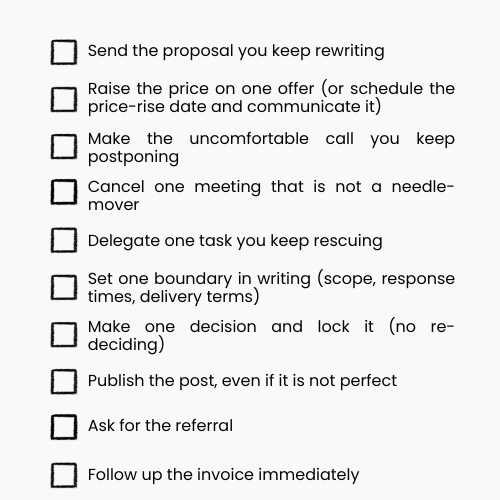
Self-trust rep ideas for SME owners
Pick one per day:
You are not trying to become fearless.
You are teaching your system: “We move anyway.”
What happens after 7 days
After 7 days, you will have something most SME owners never build intentionally:
A stack of evidence.
And that stack does not just change your behaviour.
It changes your identity.
Because identity is not what you say you are.
It is what you repeatedly prove under pressure.
Confidence will show up as a side effect.
Not because the market changed.
Not because circumstances got easier.
But because you became an operator who follows through.
The closing truth
If confidence is missing, do not hunt the feeling.
Build the evidence.
Run the loop.
Aligned action first.
Self-trust second.
Confidence last.
And if you want a clean place to start, return to the diagnostic:
Under pressure this week, did you default to your next-level standards, or your old safety patterns?
Your answer tells you exactly which identity you are rehearsing.
Now choose your rep.


